Colloidal Silver Facts
What is Colloidal Silver?
What is Colloidal Silver?
Agency for Toxic Substances and Disease Registry This Public Health Statement is the summary chapter from the Toxicological Profile for Silver. It is one in a series of Public Health Statements about hazardous substances and their health effects. Get the complete document here.
Silver-Colloids This site is dedicated to the publication and dissemination of scientific information about colloidal silver. Information contained on these pages is intended for informational and educational purposes. The authors contributing information found on these pages do not directly or indirectly dispense medical advice nor prescribe any remedies or assume responsibility for those who choose to treat themselves.
EPA Integrated Risk Information System (IRIS) Health assessment information on a chemical substance is included in IRIS only after a comprehensive review of chronic toxicity data by U.S. EPA health scientists from several Program Offices and the Office of Research and Development.
MSDS for Colloidal Silver Material Safety Data Sheet. Silver is not listed as a carcinogen by OSHA, NTP, IARC, ACGIH or the EU.
More information
Chemical Properties
Identity, groupiing and charactteriisattiion off siillver based biiociidall acttiive substtances iinclludiing nano-siillver The Federal Institute for Risk Assessment is one of two successor institutes to the Federal Institute for Consumer Health Protection and Veterinary Medicine (BgVV) which was, in turn, one of three successor federal institutes to the Federal Health Office (BGA) which was dissolved in 1994.
Chemical Properties
From WebElements - Periodic table on the WWW.
Information on Silver
Northwest Mining Association. Interesting info and some activities for students studying the attributes of silver. Mentions Argyrol.
Articles on Colloidal Silver
Since ancient times silver has been highly regarded as a versatile healing tool. In ancient Greece, Rome, Phoenicia, and Macedonia, silver was used extensively to control infections and spoilage. Hippocrates, the “Father of Medicine,” taught that silver healed wounds and controlled disease...
Research on Trace Minerals
Trace Minerals Research was founded on sound science and the basic principle that continual research will produce higher quality products. It is with this desire to use science as a tool to explain nature that we present this small collection of recent research regarding trace elements.
What does Colloidal Silver look like? Check out these scanning electron microscope photos of CS courtesy of Silvergen.Com.
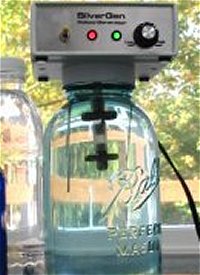
Theory on how colloidal silver works by Ken Adachi at Educate-Yourself. Tiny particles of pure silver are made to deposit into water by simple electrolysis. Two silver wire electrodes, placed in a glass of water, are attached to the positive and negative terminals of a source of Direct Current (DC) electricity.
Different Forms of Colloidal Silver There are basically six production techniques used in these silver preparations. An understanding is important because although these other preparations are referred to as colloidal silver, though in fact they are not necessarily.
What's better: Particulate vs. Ionic Silver Claims have been made by the manufacturer of Mesosilver that suggest "ionic" silver potency is compromised by Hydrochloric Acid (HCl) in the stomach, and that only the particulate [species], elemental silver (i.e. the primary content in Mesosilver) will survive and therefore be effective in inhibiting microorganisms...
Silver Toxicity Silver is a relatively rare metal that occurs naturally in the earth's crust and is released to the environment from various industrial sources. Human exposure to silver and silver compounds can occur orally, dermally, or by inhalation. Silver is found in most tissues, but has no known physiologic function.
Tyndall Effect The Tyndall Effect is caused by reflection of light by very small particles in suspension in a trasnparent medium. It is often seen from the dust in the air when sunlight comes in through a window, or comes down through holes in clouds. It is seen when headlight beams are visible on foggy nights, and in most X-File episodes when Moulder and Sculley check out some dark place with flashlights.
Silver in Nontechnology For the last 120 years, the field of nanotechnology has been devoted to researching and developing new uses for colloidal nanosilver.
NFPA Label for silver  |
Vermont SIRI MSDS Archive |